Developing Better
Climate Transition Plan
Strategic Priorities

Strategy and Governance
- Embed sustainability considerations in our total portfolio management strategy
- Strengthen governance frameworks and internal controls to support regulatory compliance

Building Efficiency and Performance
- Improve energy efficiency through Asset Enhancement Initiatives (AEI) across commercial and hospitality portfolio
- Explore electrification of equipment, where feasible

Renewable Energy
- Explore opportunities for adoption of renewable energy for owned commercial and hospitality properties
- Collaborate with business partners and supply chain on renewable energy procurement, where feasible

Embodied Carbon
- Assess significance of embodied carbon resulting from development of residential, commercial and hospitality projects
- Reduce embodied carbon emissions through sustainable design, use of low-carbon materials and green construction practices, where feasible

Collaborative Partnerships
- Work with partners to implement sustainable design and green construction practices in development projects and AEI, where feasible
- Engage tenants on green fit-out guides and green lease implementation, where feasible
- Support business partners (e.g. hotel owners, operators) in meeting decarbonisation objectives for hotel operations
Our Approach to Net-Zero
The Group recognises the importance of strengthening climate resilience. We are committed to achieving net-zero emissions across our value chain by 2050. Developed in 2025, our CTP outlines how climate considerations are embedded across our business operations and value chain. It covers Scope 1, 2 and 3 emissions and sets out a practical approach towards a more climate-resilient portfolio. Our plan is underpinned by key assumptions, including the projected decarbonisation of the national electricity grids, continued technology improvements, availability of lower‑carbon materials, as well as dependencies across our value chain, capital cycles and organisational capabilities.
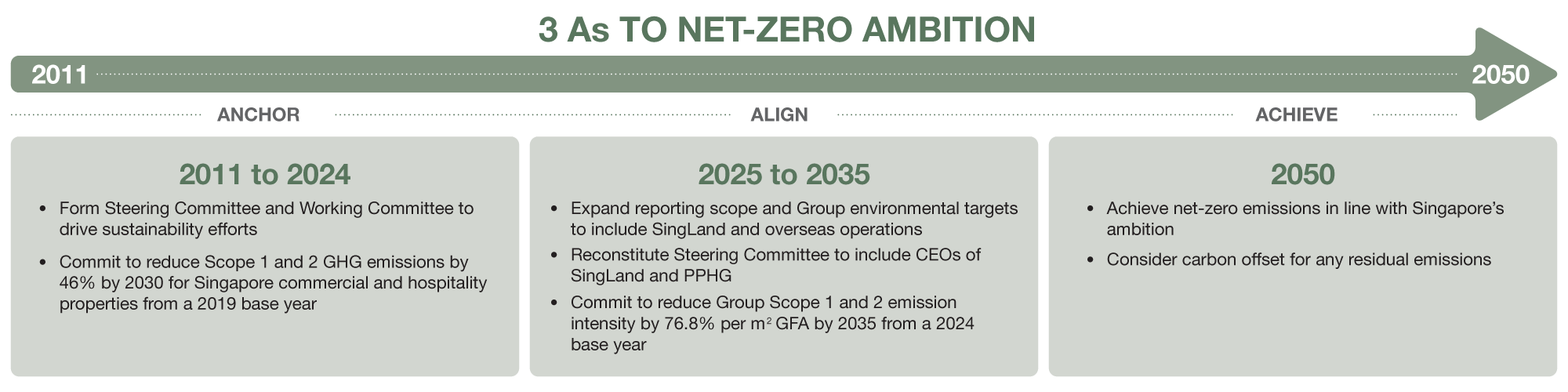
Our approach is guided by a three-stage framework – anchor, align and achieve – through which the Group establishes our net-zero ambition, aligns policies and processes, and drives measurable outcomes through defined targets and implementation priorities to achieve our net-zero goal.
Implementing our Climate Transition Plan
The Group’s CTP focuses on five key areas across our Singapore and overseas portfolio:
Embedding Sustainability into Strategy and Governance
UOL’s sustainability vision of “Less Carbon, More Life” underpins our commitment to shaping a resilient built environment and contributing to a clean, green and sustainable future. This is embedded in our business strategy, with strengthened governance frameworks and internal controls to ensure robust oversight and support regulatory alignment. The Group SCC reports regularly to the ARMSC, enabling effective oversight of sustainability initiatives, progress and key developments, and ensuring alignment with the Group’s climate transition objectives.
Sustainability is integrated across all levels of the Group, with our CTP embedded within management structures and implemented consistently across business functions. At the operational level, key functions incorporate sustainability considerations into portfolio management and investment decisions. This strengthens asset performance, enhances energy efficiency and positions the Group to achieve our long-term net-zero ambition.
Elevating Building Efficiency and Performance
The Group continues to proactively identify opportunities to enhance energy efficiency across our commercial and hospitality properties through energy audits and performance reviews. Based on these assessments, targeted retrofitting works and asset enhancement initiatives are implemented where feasible, including upgrades to lighting systems, chiller plants and optimisation of air handling units to enhance operational efficiency and reduce energy consumption. In parallel, the Group is progressively electrifying systems used for heating, cooling and transportation across our portfolio, taking into account technical feasibility and operational requirements. These efforts support the reduction of Scope 1 and 2 greenhouse gas emissions and contribute to the Group’s broader decarbonisation objectives.
Increasing Use of Renewable Energy
Renewable energy adoption is a key pillar of the Group’s transition strategy. We currently have eight properties in Singapore equipped with solar photovoltaic systems and continue to assess opportunities to expand on-site renewable generation to our overseas portfolio. The Group is also exploring the procurement of renewable energy through Power Purchase Agreements and Energy Attribute Certificates, where commercially and operationally viable. In 2025, UOL entered into renewable energy arrangements for selected properties in Australia, supporting a gradual reduction in Scope 2 emissions over time as electricity grids decarbonise. The Group will continue to work closely with business partners and support its value chain in adopting renewable energy solutions, strengthening collective progress towards our decarbonisation goals.
Assessing and Reducing Embodied Carbon across Developments
In line with the Singapore Green Building Masterplan, the Group is placing greater emphasis on managing embodied carbon across both new residential developments and AEI works within our commercial and hospitality properties. The Group computes and assesses embodied carbon for development projects to identify carbon hot spots and inform decision-making. For new residential developments, UOL incorporates sustainable design principles, specifies lower-carbon materials and adopts greener construction practices, where feasible, in collaboration with consultants, contractors and suppliers to reduce embodied carbon emissions. A similar approach is applied to AEI works and new commercial developments, where embodied carbon assessments are integrated into project planning and execution, enabling the Group to improve material efficiency and reduce lifecycle emissions across our non-residential portfolio.
Fostering Collaborative Partnerships
Collaboration across the value chain is integral to supporting the Group's sustainability and decarbonisation journey. For residential developments, we work closely with main contractors, consultants and suppliers to reduce embodied carbon in construction. The Group explores sustainable procurement of low-carbon materials and collaborates with project partners to incorporate sustainable design, optimise material use and adopt greener construction practices in selected development projects and AEIs.
In our commercial properties, we engage tenants to improve energy performance within leased spaces through initiatives such as green fit-out guidelines and the promotion of lower-carbon practices. Where feasible, we will introduce green lease frameworks in new commercial properties across our global portfolio.
For our hospitality properties, the Group works with hotel owners, franchisees, tenants, suppliers, business partners and guests to enhance operational efficiency and align environmental and social practices with evolving sustainability expectations. Where feasible, we prioritise responsible and local sourcing to reduce negative environmental impact. These partnerships drive knowledge sharing, innovation and alignment with recognised frameworks, supporting progress towards the Group’s decarbonisation goals.