Building Good
Health and Safety
Workplace safety and health (WSH) is a non-negotiable priority for the Group. We remain committed to maintaining a safe and healthy environment for all stakeholders across our operations, including employees, contractors, customers, guests and business partners. The Group’s leadership maintains strong oversight of WSH through our Environmental, Health and Safety (EHS) governance framework.
The EHS management system and policy are anchored on the “Three E” principles:
Enhancing Effectiveness of EHS Management System
We continuously strengthen the effectiveness of our EHS management system to enable early identification and mitigation of safety risks. Regular safety risk assessments, inspections and audits are conducted across commercial properties to identify potential hazards before incidents occur. Key risk areas, including building services, plant rooms, common areas, confined space work and contractor works are closely monitored.
The Group allocates resources to ensure that the EHS management system is continuously improved and remains in conformance with ISO 14001 and ISO 45001 standards. Annual trainings on ISO 14001 and ISO 45001 standards are conducted by our consultants for the working group and internal auditors, ensuring that competencies and technical knowledge remain up-to-date.
Engaging Stakeholders to Promote and Build a Proactive Safety and Environmental Culture
Safety is a collective responsibility. Clear safety expectations are communicated across the Group and stakeholders are encouraged to identify, report and address hazards at an early stage. Contractor safety management forms a key pillar of this approach. Contractors, particularly those undertaking higher-risk works, are subject to pre-qualification assessments, including reviews of their risk assessments and safe work procedures, before commencement of works. Regular toolbox briefings, site inductions and on-site monitoring are conducted to reinforce safe work practices, especially for higher-risk activities such as hot works, lifting operations, confined space work and work at height.
Embedding EHS Considerations into Planning and Initiatives
EHS considerations are embedded into operational planning, project execution and day-to-day decision-making across the Group’s portfolio. Safety risks are assessed at the planning stage of maintenance works, renovations and improvement projects to ensure appropriate controls are incorporated prior to commencement. Safety performance and risk management are also standing agenda items at monthly asset control meetings, reinforcing management oversight and accountability.
The Group strives to uphold the highest workplace safety and health standards and achieve zero workplace incidents across our global operations.
Our Approach to Health and Safety
Over the years, we have strengthened our EHS policy to enhance the management of safety and well-being across all operations. The revised policy has been communicated to all relevant stakeholders and incorporates key improvements, including more rigorous risk assessment processes, enhanced operational control through the permit-to-work system and improved incident reporting mechanisms.
The Group maintained ISO 45001 certification for Occupational Health and Safety Management Systems across all commercial and hospitality properties in Singapore. High-risk activities such as working at heights and confined space entry are effectively managed, while the rise in reporting of near-miss incidents demonstrates an empowered workforce that proactively identifies hazards without fear of blame or reprisal. For overseas, we will be rolling out a set of safety standards by 2026.
Guided by our Occupational Safety and Health Consultation and Participation Management Procedure, we have established channels for employee participation in WSH committees. These channels facilitate open communication, safety concern reporting and regular employee feedback on safety and well-being. The WSH committees review objectives and targets regularly, assess current procedures and explore new safety improvements. The Group has established an anonymous online whistleblowing channel that enables employees and contractors to share feedback or raise concerns with the Group’s Safety Officer.
During the year, UOL pledged our commitment to championing workplace safety and health by joining the WSH Advocate Programme administered by the Workplace Safety and Health Council. As part of the second intake, UOL was among 19 newly recognised companies appointed to the programme, reflecting our commitment to advancing safety standards across Singapore’s built-environment sector. The programme brings together major service buyers to drive higher safety performance throughout supply chains by embedding WSH as a core criterion in contractor selection and management.
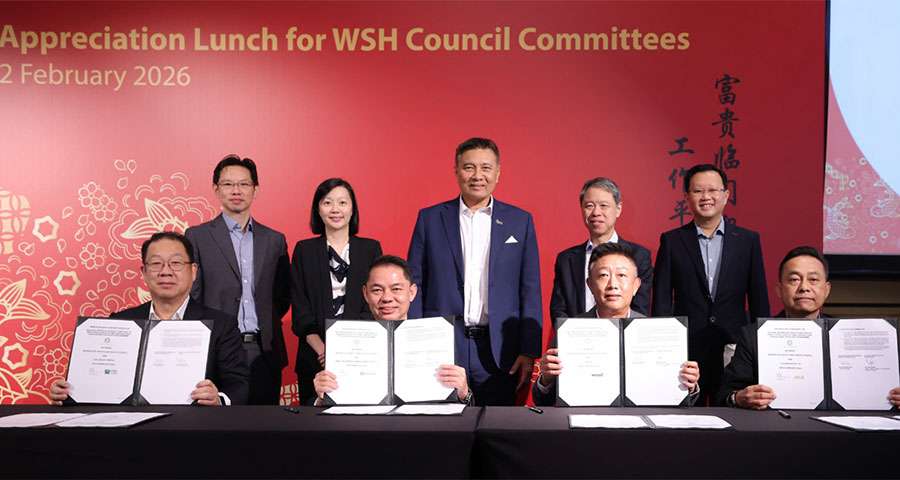
UOL’s Chief Operating Officer, Mr Neo Soon Hup (first from left), at the WSH Advocate Programme signing ceremony.
WSH Management System
The Group has implemented a comprehensive and integrated management system aligned with ISO 14001 and ISO 45001 as well as the Approved Code of Practice (ACOP) for Chief Executives and Board of Directors. The system covers the implementation and monitoring of safety measures, incident tracking and reporting, regular safety briefings and site inspections, and ongoing reviews of WSH risk assessments and documentation. These processes support systematic hazard identification and the implementation of appropriate control measures across operations. In 2025, UOL and PPHG integrated both ISO 14001 Environmental Management System and ISO 45001 WSH Management System into a single, unified management system. The integrated system underwent an external audit in Singapore in 2025 and achieved zero non-conformities. In 2025, SingLand successfully completed the ISO 45001 surveillance audit for the second consecutive year following initial certification, with no major findings.
Risk assessments are conducted by trained personnel using a systematic approach that involves reviewing incident records, inspecting work areas and equipment and consulting employees. These enhanced risk assessments are carried out in accordance with ISO 45001 and Ministry of Manpower (MOM) guidelines. Where practicable, upstream risk controls, such as engineering controls, are adopted and implemented. The outcomes of these risk assessments are regularly communicated to employees to reinforce awareness and safe work practices.
For non-routine situations, including the introduction of new equipment, workplace modifications, or significant process changes, we conduct comprehensive risk reviews to identify hazards and implement appropriate mitigation measures. The results of these reviews support continuous improvement of the WSH management system and performance. The Group prioritises strengthening safety controls in high-risk activities. Prior to commencement, all such activities require proper documentation and risk assessments, supported by a permit-to-work system to ensure effective operational control and management of workplace safety and health.
Reporting and Responding to Incident
While our primary focus is on proactive prevention, we recognise that preparedness for potential crises is essential to protect lives, minimise harm and maintain the confidence of employees, contractors, tenants and other stakeholders. Accordingly, the Group manages work-related hazards and occupational ill-health using a hierarchy of controls framework aligned with the MOM's WSH Risk Management Code of Practice. All incidents are investigated through a structured incident management process, with corrective actions developed in accordance with the hierarchy of controls and incidents classified by severity to ensure timely resolution. To support continuous improvement in WSH performance, investigation findings and lessons learned are communicated promptly to relevant stakeholders, while employees are empowered to proactively identify and report potential hazards through the Group’s incident and hazard reporting channels.
In 2025, the Group recorded one fatality at a worksite for a SingLand redevelopment project and 221 recordable work-related injuries across our portfolio. This data encompasses employees and contractors across our global commercial and hospitality properties as well as development projects. In response to the fatality incident, the Group worked with the project’s main contractor to provide immediate response and ensured that thorough investigations and mitigation plans were in place to reduce the risk of recurrence.
Development Projects
UOL collaborates closely with our main contractors to maintain a safe environment for all workers involved in our development projects. All main contractors are required to be ISO 45001-certified and ensure that every site has robust safety measures in place. These include the appointment of designated safety supervisors and personnel responsible for conducting regular safety briefings, site inspections and training on worksite safety and related hazards. In response to increasing climate-related risks, such as rising temperatures and extreme weather events, main contractors have implemented adverse weather management plans to support worker safety, emergency preparedness and timely response.
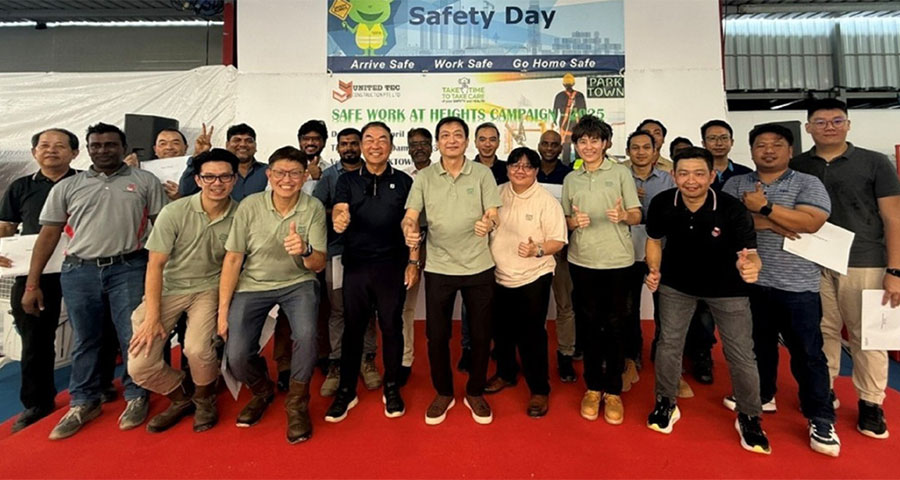
Safety Campaign Day was conducted at PARKTOWN Tampines to share workplace safety and health awareness among contractors and staff.
To uphold safety standards, we conduct monthly joint safety inspections at each development project site that we manage. These inspections are led by our appointed safety consultant and the Group’s Safety Officer, along with project managers, consultants and main contractors. Safety performance is regularly monitored through site meetings and quarterly reports. Main contractors are also required to report any reportable injuries at site meetings and submit comprehensive case reports to ensure accountability and continuous improvement in safety practices. For development projects managed by our joint venture partners, the appointed safety consultant provides full-time on-site safety personnel to oversee implementation of safety measures. All safety incidents are reported to UOL through formal incident reports to ensure timely escalation and appropriate follow-up actions.
| Other workers (e.g. Other contractors) |
|
|---|---|
| No. of workplace fatalities | 1 |
| Fatality rate | 0.1 |
| No. of recordable work-related injuries (including fatalities) | 7 |
| No. of high-consequence work-related injuries (excluding fatalities) | 0 |
| High-consequence work-related injuries rate | 0.0 |
| No. of occupational diseases | 0 |
| No. of dangerous occurrences | 0 |
| No. of lost days (including fatalities) | 6,024 |
| Lost day rate | 667.0 |
| Lost time injury frequency rate | 0.8 |
| Total no. of man-hours worked | 9,031,810 |
Similarly, for SingLand, strong emphasis is placed on health and safety across all asset enhancement and redevelopment worksites. Main contractors are responsible for designing and implementing safety management system in accordance with Singapore’s Workplace Safety and Health Act, and worksites undergo mandatory audits every six months as required by MOM. In addition, regular safety inspections are carried out by SingLand's appointed safety consultant, the Group's Safety Officer and SingLand project teams.
In 2025, our contractors recorded one fatality and seven recordable work-related injuries, which resulted in 6,024 lost days. Our lost day rate increased to 667.0 in 2025 due to additional 6,000 lost days included as a result of the fatality.
Commercial Properties
EHS considerations are embedded into operational planning, project execution and day-to-day decision-making across the Group’s commercial properties. Adopting a Safety in Design for Maintenance approach, safety risks are assessed at the planning stage of maintenance works, renovations and improvement projects, with engineering controls prioritised where feasible to eliminate risks at source. These include the incorporation of permanent access provisions such as fixed ladders, platforms, permanent guardrails and fall protection systems before work commences. Lessons learned from incidents, near-miss incidents, inspections and maintenance feedback are continuously integrated into future design and improvement initiatives, helping to reduce residual risks, enhance operational resilience and provide a safer working environment across the operational life of the Group’s commercial properties.
In 2025, our commercial properties recorded six recordable work-related injuries among employees.
| Singapore | Overseas |
|||
|---|---|---|---|---|
|
Employees |
Other workers |
Employees |
Other workers |
No. of workplace fatalities |
0 |
0 |
0 |
0 |
Fatality rate |
0.0 |
0.0 |
0.0 |
0.0 |
No. of recordable work-related injuries (including fatalities) |
6 |
0 |
0 |
0 |
No. of high-consequence work-related injuries (excluding fatalities) |
1 |
0 |
0 |
0 |
High-consequence work-related injuries rate |
0.8 |
0.0 |
0.0 |
0.0 |
No. of occupational diseases |
0 |
0 |
0 |
0 |
No. of dangerous occurrences |
0 |
0 |
0 |
0 |
No. of lost days (including fatalities) |
266 |
0 |
0 |
0 |
Lost day rate |
223.3 |
0.0 |
0.0 |
0.0 |
Lost time injury frequency rate |
5.0 |
0.0 |
0.0 |
0.0 |
Total no. of man-hours worked |
1,191,283 |
1,288,596 |
19,217 |
92,448 |
Hospitality Properties
Health and safety remain a core priority in managing our hospitality properties. The Pan Pacific Cares programme reflects our commitment to deliver the highest standards of safety, well-being and hospitality services to guests across our hospitality properties. It complements our existing strict cleaning and hygiene protocols to ensure a safe and clean environment for our guests and employees. To uphold these standards, our hospitality employees are required to undergo regular health and safety refresher training sessions, covering the emergency response, first aid, fire safety, security awareness and risk-based safety practices for all associates.
Across Singapore, each hospitality property has a designated health and safety representative and a dedicated WSH Committee responsible for reviewing incidents, assessing risks and identifying areas for improvement. In addition, all Singapore hotel properties will introduce workplace injury reduction targets as KPIs for department heads, encouraging the development of proactive safety initiatives and action plans to prevent workplace injuries within their respective areas of responsibility.
In 2025, our hospitality properties recorded 208 recordable work-related injuries among employees and other workers, including contractors, suppliers and interns.
| Singapore | Overseas |
|||
|---|---|---|---|---|
|
Employees |
Other workers |
Employees |
Other workers |
No. of workplace fatalities |
0 |
0 |
0 |
0 |
Fatality rate |
0.0 |
0.0 |
0.0 |
0.0 |
No. of recordable work-related injuries (including fatalities) |
110 |
26 |
66 |
6 |
No. of high-consequence work-related injuries (excluding fatalities) |
0 |
0 |
3 |
0 |
High-consequence work-related injuries rate |
0.0 |
0.0 |
0.6 |
0.0 |
No. of occupational diseases |
0 |
0 |
0 |
0 |
No. of dangerous occurrences |
0 |
0 |
0 |
0 |
No. of lost days (including fatalities) |
613 |
46 |
449 |
20 |
Lost day rate |
150.9 |
105.7 |
82.4 |
29.5 |
Lost time injury frequency rate |
27.1 |
59.7 |
12.1 |
8.9 |
Total no. of man-hours worked |
4,061,173 |
435,246 |
5,451,501 |
677,600 |
Food safety is a critical priority in the hospitality industry and fundamental to safeguarding the health and well-being of our guests. To uphold high food safety standards, PPHG has implemented a Food Safety Management System (FSMS) aligned with Hazard Analysis Critical Control Point (HACCP) standards. All hotels in Singapore maintain HACCP certification, supported by structured food safety training programmes and regular audits across the entire food chain, from the receipt of raw ingredients to food preparation and service.
All new employees receive mandatory food safety training upon onboarding and food handlers are required to complete certification training before assuming their roles. These requirements are reinforced through regular refresher training and frequent kitchen inspections to uphold strict hygiene standards. Any identified lapses are addressed promptly through corrective actions and, where necessary, disciplinary measures. Regular kitchen audits further verify compliance and identify areas for improvement, with action plans implemented within defined timeframes to support continuous improvement in food safety performance.
In response to higher risks and exposure in Singapore, we implemented stricter food safety measures in 2025. These enhanced measures include:
- Increasing food sample testing to detect and contain potential contamination early
- Conducting more frequent kitchen inspections and enforcement of regular self-inspections by kitchen staff
- Training kitchen associates in “Just-In-Time” ordering practices to minimise hygiene risks associated with expired items and reduce food wastage
- Installing knife sterilisers and replacing chopping boards to maintain high hygiene standards
- Requiring mandatory health declarations for food handlers and F&B associates, where each team member must confirm fitness for work at the start of every shift via QR code or roster sign-off
- Reinforcing consistent date-labelling and monitoring practices to ensure the freshness and safety of all food items
- Trialling extended colour-coded labelling for dry and frozen items with longer shelf lives, enhancing clarity in storage and usage protocols
- Implementing data temperature logging system for continuous monitoring of chiller and freezer temperatures with alarms features
Our approach extends beyond incident management as we remain vigilant in monitoring food safety trends in Singapore to uphold the highest standards for our guests’ well-being.
During the year, 22 food safety complaints were reported and investigated, including laboratory analysis where required. None of these incidents were substantiated, with all results deemed satisfactory. As a precaution, PPHG implemented enhancements to its food safety processes to mitigate potential risks. No significant food safety incidents were recorded in 2025.
Health and Safety Training
The Group places strong emphasis on training employees in workplace health and safety standards. All applicable employees are required to complete training programs aligned with our WSH Training Matrix, which addresses the specific needs of different property levels across our commercial and hospitality businesses. Mandatory safety training ensures compliance with legal requirements and covers high-risk activities. All new employees undergo safety orientation programmes that introduce workplace safety practices, emergency procedures and incident reporting protocols.
To support accessibility to safety information, we revamped our WSH intranet channel, providing employees with easy access to safety procedures, guidelines, checklists, permit-to-work forms and ISO documentation. Regular refresher training, conducted both internally and externally, reinforces critical safety knowledge and prevents complacency. These training programmes are implemented consistently across Singapore and overseas operations, covering workplace hazard identification, safe work practices, emergency preparedness, incident reporting and the proper use of personal protective equipment. Within the hospitality business, all employees are also required to complete mandatory food safety training, supported by annual refresher courses to maintain awareness and competency.
To further strengthen readiness and WSH competency, the Company conducted scenario-based drills in 2025, including joint fire evacuation exercises, Business Continuity Plan (BCP) simulations, missing-person drills, medical emergency responses and room-hazard training. In addition, SingLand implemented a cyclical risk assessment programme for its Singapore office and retail properties to proactively identify and mitigate emerging hazards, further strengthening its system with the introduction of additional checklists for hazardous work activities.